Apparently Okaloosa’s Northwest Florida Regional Airport is not closing, and Okaloosa Airport officials are getting quite snappy about it. I’ve heard this very rumor for quite some time and have actually participated in some of the speculation.
Some believe that it all started January of 2008 with the Panama City Beach’s Chamber let out an email blast to members that stated that Eglin Air Force Base would shut down commercial airport operations in order to preserve Eglin’s incoming Joint Strike Fighter mission. I personally remember the email and thought it quite a bold move, but was unable to substantiate the statement.
Other locals to Panama City and Panama City Beach have been known to question whether the Okaloosa airport would stay open for much longer, including well-known attorney, William Harrison and former Panama City Beach Mayor and local news show host Lee Sullivan. Recently, Sullivan had Panama City Bay County International Airport Director Randy Curtis on his show and made the comment that in the future Okaloosa would have airspace issues with Eglin that may lead to complications in commercial operations. Harrison’s opinion is that it is of the best interest of the Florida Panhandle that Eglin’s military and the Joint Strike Fighter mission is of the highest priority.
Currently the Okaloosa County Commission is investigating the possibility of legal action against the Panama City Bay County International Airport and have also supported seeking the resignation of Jerry Ray from Coastal Vision 3000. Ray is one of the VP’s of St. Joe and a prominent supporter of the New Panama City Airport.
Okaloosa’s Northwest Florida Regional Airport Director Greg Donovan said that they will be launching an advertising campaign to counter the rumors. Recently the Air Force renewed their lease with Northwest Florida Regional through 2032.
With the likeness of a modern game or reality show, the suspense was lingering and drawn out. Chairman Girvin surely is a student of this dramaticism. The presentation from Dan Rowe, Executive Director of the Bay County Tourist Development Council (TDC) and President of the Panama City Beach Convention and Visitors Bureau (CVB) was short and not even necessarily sweet. It was almost as though he was there only because he needed to be. Not that Rowe was unwilling, but it seemed apparent that this was all part of a strategy.
Last month the Bay County Commission passed with a majority vote to increase the bed tax collected from 3 cents to 4 cents. In order to pass the 5th cent increase, a super majority vote was required, that is to say that 4 of the 5 commissioners had to vote in approval. The lack of the super majority support on the 4th cent influenced Commissioner Mike Thomas to request that voting on the 5th be tabled until the regularly scheduled meeting that was held today so that his fellow commissioners could further educate themselves on the ramifications of this decision.
Out of the six that spoke up about the bed tax increase during the public comment section, 4 spoke in opposition of the increase and 2 spoke in approval. Among the two one worked for St. Joe, and the other was Chairman Tannehill of the Airport Authority. Tannehill mentioned that we cannot overlook this opportunity to help Bay County grow. “Everybody asked for it, we’re giving it to them, we need to be sure it’s gonna work,” he continued.
After Chairman Tannehill spoke, Chairman Girvin asked if anyone else had any comments. “This room is full of people that have concern either for or against this issue, I can’t beleive that nobody has anything else to say about it,” he said.
There were three motions total, with the first two from Commissioner Mike Thomas, which ultimately failed to carry. The first motion was to allow the increase to pass with no restrictions, the second was to limit the bed tax to 5 years (the same as the resolution), but to allow the TDC to spend it as they see fit.
The third motion was made by Commissioner and TDC Board Member Mike Nelson. Discussion led everyone down the road that resulted in some flexible conversation on the part of Chairman Girvin. He seemed to be making suggestions as to what he could agree with. Commissioner Bill Dozier at one point asked Chairman Girvin “I can’t be comfortable with the motion until you are comfortable with it, are you comfortable with it?” Girvin: “Well, I don’t know!” I had to chuckle as at this point, it seemed as though he was being purposefully suspenseful.
Commissioner Nelson’s initial motion was unclear and after many minutes of conversation it was restructured to adopt the Resolution that the TDC approved yesterday and to approve the increase.
With no discussion left, Chairman Girvin ordered the roll called. Going through the ranks, Thomas-yes, Dozier-yes, Gainer-no, Nelson-yes, Girvin- “Before I vote, I would like to make a comment. No matter which way I go on this, someone will be upset. I have great respect for many of the people on both sides of this issue,” he said. “However I have to make the decision that is best for Bay County, as these are perilous times for us, and we need all the help we can get. On one of the sides, not everyone has been completely honest with me. I think we would be in err if we didn’t at least give it a try for five years, and with that said, I vote YES.”
When his vote came through after a suspenseful comment, you could hear the crowd sigh and almost burst into applause. Tourism industry leaders could be seen with ear to ear grins as a seeming victory had been won, as if this was some sort of battle. I’ve not always agreed in the past with the way the TDC has spent money, and I’m sure I won’t always agree with them in the future, but I think this was a good move and an innovative way to move forward.
Having said that, I just want to be clear on how this money will be spent, as there seemed to be some confusion at the meeting that these funds could be used to directly subsidise an airline – and I don’t think this is the case, as it was explained yesterday (someone, please chime in if I am incorrect).
This 5th cent will be used for advertising, in a cooperative relationship with an airline(s) that may have an interest in flying into our new airport. For example: a string of advertisements in Chicago that would advertise special rates with X airline on trips to Panama City Beach, FL. This would give incentive to the airline that their flights here would be well occupied and increase the number of people exposed to our beautiful area.
Good form Commissioners and Board members, good form!
New aerials have been released of the construction progress at the new aiport site in West Bay in North Bay County. The new airport in Panama City Beach is located on 4,000 acres of land donated by the St. Joe Company with the current infrastructure footprint using 1400 acres of the property.
This photo shows the terminal and main parking area. The left side of the picture is south whereas the right side of the picture is north (or approximately). The U-shape onthe bottom is the pavement around the main wing of the terminal with the T-shape (with the stem of the T fitting in the U) being the actual terminal footprint. The box-shapes above the terminal area is the main parking with the cleared area above it (I beleive) will be auxilary parking. The area to the left is the general aviation area.
On the Heavy Civil and Airfield Lighting contract, the construction team has completed 75% of the contract work and used only 51% of the contract time. The following milestones have been reached:
85% of the 15” concrete paving lanes have been placed on 8,400 linear feet of Runway 16-34.
Runway 16-34 Touch Down Zone and Centerline light cans are being set.
On Taxiway D and main terminal apron, all lime rock base and the first lift of asphalt paving is in place.
Production volumes in place are as follows:
62,354 tons of asphalt pavement in place (both airside and landside).
151,307 square yards of landside lime rock base and 130,885 square yards of flightline P-211 lime rock base have been installed in accordance with the project specifications.
47,000 cubic yards of the 67,200 cubic yards of 15” concrete runway pavement is in place.
98% of the original RCP storm sewer installations are complete (33,086 linear feet).
66,258 linear feet of perforated under-drain has been installed along the taxiways and runways (42% of total).Storm sewer installation within the General Aviation Area is 30% complete.
5.7 million cubic yards of earth has been moved (99% of total).
Mass grading within Pond C now 98% complete.
105 pieces of heavy equipment in operation at any one time with approximately 123 personnel on site.
Contract 2: Terminal Building, ATCT and Support Buildings
On the Terminal Building, ATCT and Support Buildings contract, the construction team has completed 14% of contract work and utilized 19% of the contract time. Specific work includes the following:
Terminal: Shoring for Level 2 areas B and C continues in the terminal building.
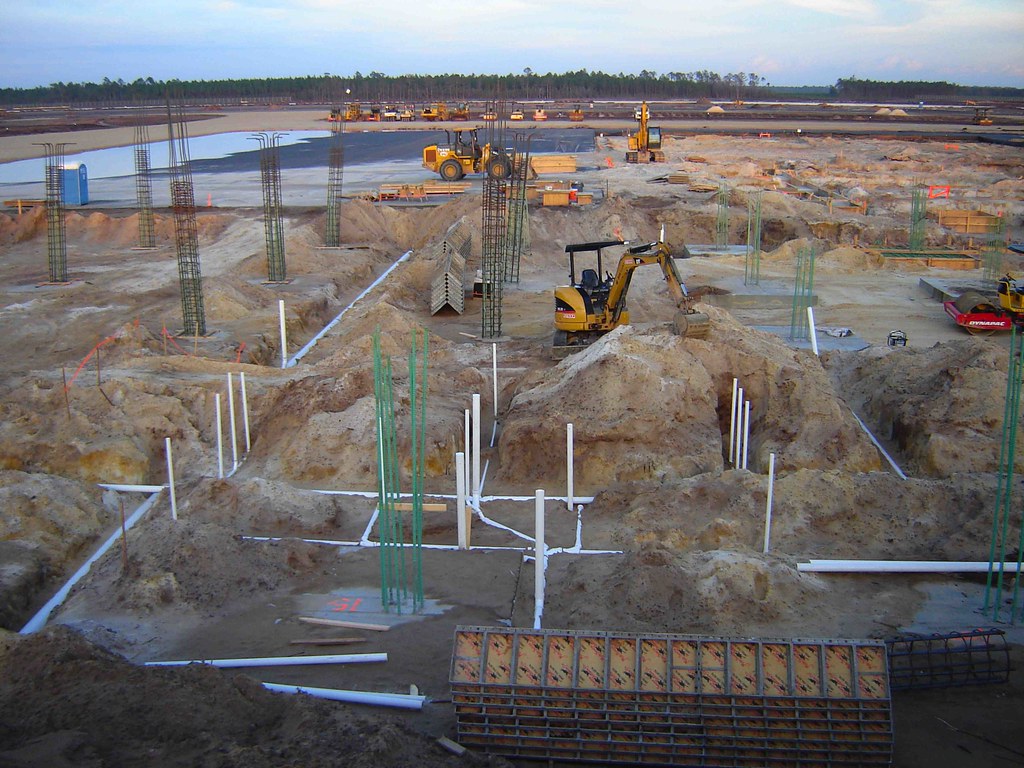
Terminal: Plumbing rough-in continues.
Air Traffic Control Tower: Excavation around auger cast piles is complete and ready for installation of pile cap.
Air Cargo Facility: Completed slab pour at truck well/forming retaining walls.
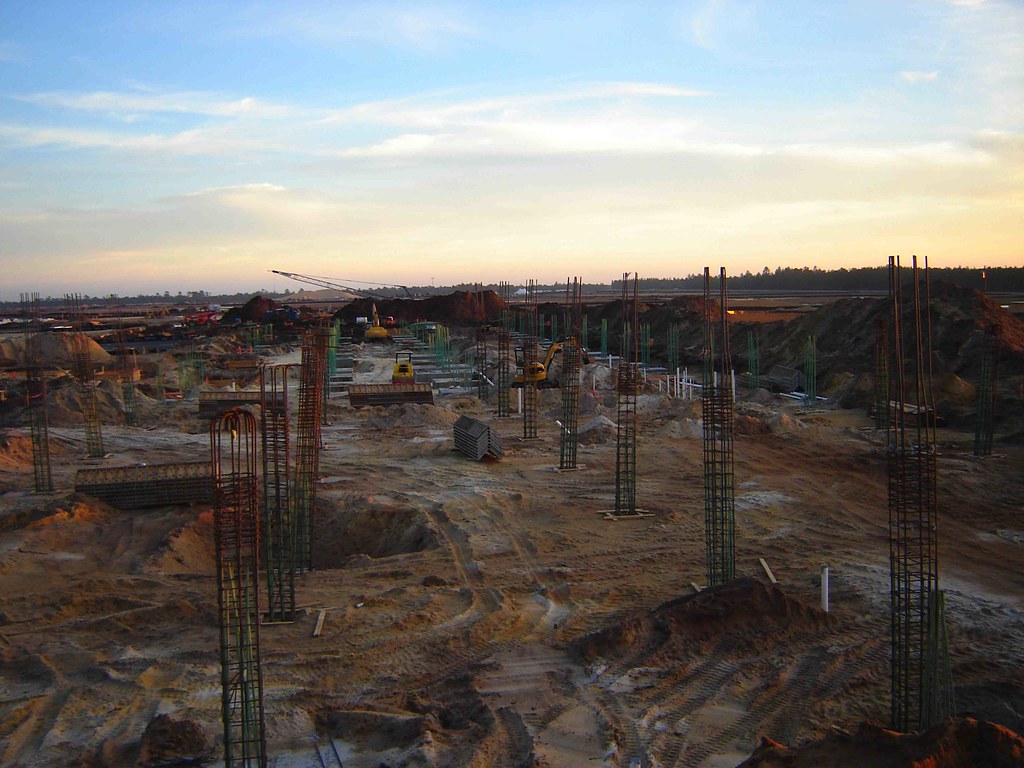
Public Safety Building: Rebar at perimeter footings nearly complete.
Contract 3: Utility Contract
On the Utility Contract, the construction team has completed 4% of contract work and utilized 6% of the contract time. On the Main Access Road:
That’s right, the approved 8,400 feet of the main runway at the new airport site in Panama City is complete. With the exception of the center where the runway lights will be installed, they are done. Approval should come shortly from the FAA for the extension to the full 10,000 feet which will take just over 14 days to complete.
Onsite, they have the capability to produce concrete at the pace of filling a new mixing truck every 2.5 minutes so the actual paving goes pretty quick. The concrete layer is 15 inches thick and it lays on top of 4 inches of asphalt. The density is also much greater than the stuff you use to to pour your home’s foundation.
The terminal barely resembles a frame right now but is coming along. Construction time on the terminal will last almost the duration of the project, along with te air traffic control tower. The air traffic control tower has 72 piles already installed that reach 45 feet into the earth. Instead of using pre-cast piles, they used auger-cast piles said Roy Willett, Senior Project Manager of KBR. Auger-cast piles are set by drilling into the ground, and as the dirt comes up, it is replaced with concrete, all the while placing a steel rebar pole down the middle for reinforcement. In the video, you can see where the earth movers are digging around the rebar to clear out the top of the pilings.
In my interview with Dr. Ed Wright, stand-in director of the Bay County Economic Development Alliance, it was mentioned that he wasn’t sure if the new airport would need any modifications with regards to turn-radius/taxiway requirements to accommodate the large Airbus A380 or other large cargo aircraft. Willett confirmed that short of the largest of the Antonov and the largest of the Airforce’s cargo planes, the new airport will be able to accommodate it all with the 10,000 foot runway – turning radii and all. Awesome, just flat-out awesome.!
The Panama City Airport relocation is moving along quickly with the main runway almost completely paved. The prep work has been done for the extension to 10,000 and upon FAA approval, will be complete within a couple weeks. The Terminal is under construction, as well as the air traffic control tower.
"The nature of our area will change forever, and in a great way."
Dr. Ed Wright, former Dean of FSU-PC and current stand-in director of the Bay County Economic Development Alliance was gracious enough to start our series of Leader Profile interviews that will showcase the local talent that our area possesses. Dr. Wright shares with us his former role as Dean, his current role as EDA Director, and what we may see in the future of Bay County.
Koertge: You are the former dean of FSU-PC, how long were you the dean?
Wright: Almost seven years.
Koertge: Did you move to Panama City for that specifically?
Wright: I did. I was serving as the Dean of Humanities and Social Sciences at Colorado State University when The Florida State University position was advertised. My wife and I had long connections with Panama City, had come here to the beach many times, plus my wife had family just outside New Orleans, so it was close. In addition, I had done a lot of work with Gulf Coast Community College. I was happy where I was, very successful and doing well, but when I told my wife about the position, she said four words to me – ‘get your typewriter out.’ This was the only time I applied for a job in several years and low and behold, we ended up coming.
Koertge: So, tell us about the timing of your move.
Wright: It was just the right time for me, and it was time for real growth at FSU-PC. FSU had been fairly unresponsive prior to my coming to the needs of the community and the community was getting a little restless about it. That was communicated to me pretty quickly. When the dean before me, Larry Bland, who was the founding dean – great guy, had been here for years – retired, they put together a commission of city and university people to talk about the future of the campus. This group came up with a plan or rather an inventory of needs. Part of my role in the beginning was to respond to that inventory of needs. Of the many things we did, we brought in daytime programs, as well as other educational programs to help broaden our teaching capability. However, one of the most important programs we brought on was the engineering program. The initiative was to create a real full time or day time campus.
After about 6 years in the seat, we decided it was time to retire. It was time to spend time with family and my mother, and also we timed it because the new buildings coming along. We figured with the new buildings and a great enthusiasm and buoying up of support – what a great time for a new Dean to be here and benefit from that very important time. And, now they are online, and what a great thing that is. I walked through them the other day, and they are very nicely done.
Koertge: If you could name one, what would you say was the highlight of your career at FSU-PC? Wright: One highlight of my career is crystal clear to me, and it is a story that I’ve told hundreds of times. This story captures the mission of a regional campus, it captures Panama City, and it captures what FSU Panama City has become. The first graduate of the Electrical Engineering program was a young woman. The commencement was always the highlight for many of us because you get to see all these people that have worked so hard come to the conclusion of their educational career with high hope for what the future will bring them. Many of them, for a long time were non-traditional students achieving their goals and making a difference in their life and in their future. So, here’s a gal who was a single mom with three kids, living at home with her parents, working as much as she could – the day she walked across that stage, her life changed forever. Now she’s working a great job, has been there for years, and has been able to offer her kids a life they never could have had before. And, importantly, the life of the community changed forever because her role in It will be different, her contribution to It will be different. That’s really what this is all about.
Koertge: What is the Bay County Economic Development Alliance? Wright: the EDA is a public/private partnership consisting of county municipalities in partnership with private companies such as St. Joe, Gulf Power and various others that contribute or have an interest in the economic development of our area. The whole purpose of the EDA is to attract new businesses and employment opportunities and help existing industries to expand and bring new business. The board is a volunteer board led by Lisa Walters, a partner in Burke and Blue. She’s a great gal, works so hard.
Koertge: What roles does the Economic Development Alliance play in the community?
Wright: The whole purpose of the EDA is to develop proposals, to target businesses that could benefit from it, provide industry related information to businesses, participate in marketing events (sometimes jointly with the Great Northwest), working with companies that may want to relocate here to perform site location studies among other things, and to structure and develop packages of incentives that are provided based on certain qualifications of the businesses. The EDA’s job is to market the region and work with those that would like to develop as potential employers in our area. Nextel and Oceaneering coming to Bay County are some examples of past EDA efforts.
Koertge: What is your role as the temporary director of the EDA? Wright: Well, first, try to keep the place running (laugh). I came down the week before Ted [Clem] left and received lots of briefings about the current goings-on in our program. 2008 closed out with 11 active projects in the works and I’m also involved in facilitating the building of new relationships. I’ve worked with three inquires in the two weeks I’ve been here from companies interested in our area or in the Southeast that may develop into fruitful relationships – we are in the business of developing proposals catering to these types of solicitations.
In addition, equally important, and maybe even more important, rather, is the search for a new executive director. We’ve got to develop a process to bring about that search and to find the right kind of person for this position.
Koertge: People, locals and tourist alike, tend to overlook Port Panama City, what do you see on the horizon as far as economic development with regards to the port? Wright: Certainly, I think, Wayne Stubbs has done a terrific job as the director of the Port; he has certainly expanded their capability. They have some land constraint issues, but that is alleviated by their having an industrial area right up 231 that is directly connected by rail that is actually being developed – that’s a really important site for future development. I think that we’ll see some activity that will make that land more interesting to a potential business that may come here in the near future.
There is a lot of potential, and we are going to try and accelerate that process so some of the ground work is complete for that future potential business. Then of course, there is the distance from the Yucatan. You know, this port is closer to the Yucatan than Miami, because from the Yucatan, you have to go around Cuba to get to Miami. Not to mention the progress with the new Panama Canal and the possible future activity that could open our area up to with the capability to accommodate much larger ships.
Koertge: Can you speak into those things unique to our area that are setting the stage for Bay County to explode? Wright: The industrial park around the airport and the developable property within the fence, about 400 to 500 acres, in terms of aviation related business is a huge advantage that our area will have. In the future, we will have tremendous opportunity that may be difficult to foresee at this time. For example, with the airbus A380 project, if the timeline of the new airport were more further along, we would have very likely been the site instead of Mobile. So, there are lots of things that could happen that are related to access to an airstrip or runway that this site certainly affords.
And of course, the whole commerce park outside the fence has the potential for logistics and cargo-related types of businesses, and its a great opportunity for businesses to build what they want as opposed to trying to retrofit something that is already there. Something else that is sometimes overlooked is the growing number of defense contractors that support the Navy base, Air Force research lab, and the Civil Engineering center at Tyndall. We’ll see that number grow.
The Navy base has become, really, a hub for a lot of different technologies. In fact, one of the things I tried to do after I retired but was still doing some work here was to get the new airport to be a test bed for new technologies. It is a great place and opportunity because you can bring a new system in, plug it in and see how it works.
Finally, where in the southeast can you land a large cargo aircraft with relative ease, and with ease, I don’t mean in regards to the length of the runway, but in regards to the amount of airspace. This airport will have lots of available airspace, timewise, with regards to cargo operations. Now, nothing is happening in this specific arena, so I don’t want to mislead anybody, but I’ve always believed that we have the opportunity when the economic base is sufficient to talk about a regional cargo kind of location. We will have lots of space to develop the kinds of distribution centers that you would need and plenty of space in terms of airspace and times that you can have access to the airspace.
And I still believe that if Airbus will manage to become profitable in their manufacture of their huge cargo carrier, the A380, then FedEx and UPS may pick up a dozen a piece. Where are you going to fly that huge plane into? Currently there is only one airport in Florida that can handle a plane of that size in terms of runway length and turning radius capabilities – Miami. As I understand, our airport should be able to handle something like this, however, they may have to do some modifications to accommodate turn radiuses and taxiway requirements, but again, we’re dealing with a clean slate. These are some of the kinds of things that we will have to offer.
Koertge: What sort of regional impact does the new airport potentially have? Wright: Oh, its huge. And we haven’t even begun to talk about the impact it will have on The Beach, if you will, the destination of Pensacola to “the bend”. And the way it potentially changes this tourism market in terns of access, if we get a low cost carrier. We’ll get people coming out of larger cities that have never heard of our area before and the potential to bring international travelers. This will change the nature of this destination forever, in a great way.
This is looking from the south towards the north. The segment off to the right will be the cross-wind runway. To the far left of the property, you can see a portion of the road that leads up from highway 388. The main runway, obviously, is right down the middle.
In this photo, you can see the terminal and main parking area. the upside down U shape is where the terminal will be, I’m not sure that I can tell the overall footprint shape in this picture.
This is looking west from the east, the terminal is on the far side with an exterior service road shown leading to the bottom of the picture.
This picture more highlights the cross-wind runway.
A proposed road from State Highway 77 in Bay County to Highway 98 in Walton County is up for discussion. Initially, the two lane Highway 388 that runs by the new airport will be widened to 4 lanes between Highway 79 and Highway 77.
The new addition to the roadway will extend from Highway 79 west to Highway 98 in Walton County just east of Peach Creek. I’m unsure at this point how they will get over the water – maybe use the Highway 79 bridge as the connector?
Through a series of public meetings, planners will devise strategic development plans and engineering ideas to bring together both new sections of the proposed roadway. Early estimates for the planning portion of the widening Highway 388 ring in at around 36 months.
Thursday, January 22 a public workshop will be held at the Panama City Beach City Hall at the intersection of Back Beach Road and Highway 79 from 5:30 to 7 pm.
Well, someone else has outdone me. There is a new video of the new Panama City airport up in West Bay that has been posted to the newpcairport.com web site.
Of course, I could probably put something together equally as awesome had I been given the opportunity to get on a helicopter! Kidding, but not really. Actually, I don’t know how to do those cool transitions – after effects?
Anyway, kudos to the creater – this vid is awesome.
Construction at the new Panama City-Bay County International Airport continues to run smoothly and is currently about 3 and a half months ahead of schedule. A summary of the contracts underway follows.
Contract 1: Heavy Civil and Airfield Lighting:
115 pieces of heavy equipment in operation at any one time with approximately 160 personnel on site.
46% of time utilized (360 of 780 days).
37% of the 15” concrete paving lanes have been placed on 8,500 linear feet of Runway 16-34.
On Taxiway D, all lime rock base and the majority of the first 2” lift of P-401 base have been placed.
12,902 tons of asphalt base course is in place along the Main Access Road (MRA) and loop road. Curb and lime rock base installation within terminal parking lots now 100% complete. Asphalt base course is in place over 75% of main parking lot.
34,888 tons of asphalt base and 20,000 cubic yards of structural concrete have been placed on 8,400 linear feet of Runway 16-34.
6,780 tons of asphalt base has been placed on Taxiway D, and the main apron.
Stormwater drainage pipe installation is now 99% complete.
Storm sewer installation within the General Aviation Area is now underway.
Over 5.4 million cubic yards of earth has been moved (98% of total).
Mass grading within Pond C now 90% complete.
Contract 2: Terminal Building, ATCT and Support Buildings:
Gulf Power has completed installation of temporary overhead power to the Terminal Building location and site office trailers.
Installation of reinforcing steel continues along Area’s A and B of the Terminal Building.
New design of the Air Traffic Control Tower auger cast piles was required due to the original design not meeting the required load test. The original design required 72 piles drilled to a depth of 52 feet. The new design, based on the actual field load tests will require 44 piles drilled to a depth of 70.33 feet and 28 piles drilled to a depth of 80.33 feet.
Rough-in of electrical and plumbing for the Air Cargo Facility is completed.
Installation of mat reinforcing steel and dowels for the Air Cargo Facility is completed.
Installation of the drainage structures for the Airport Maintenance Facility continues.
Contract 3: Utility Contract:
Contract has been executed and all necessary submittals, insurance and bonds have been received from the Contractor. Notice to Proceed is anticipated within the first week of January.





 PCBDaily