New Publix, Office Depot, Dunkin Donuts almost ready

_mg_6944wtmk

Only months away from opening, the new Publix, Office Depot, Dunkin Donuts and other soon to be announced businesses at the intersection of Beckrich and Back Beach Road are nearing completion more every day.  Scheduled to open late spring, the front of the main building structures are almost done and looking nice.

The curb work is in and the ground prepped for paving, which should happen in the next couple of weeks.

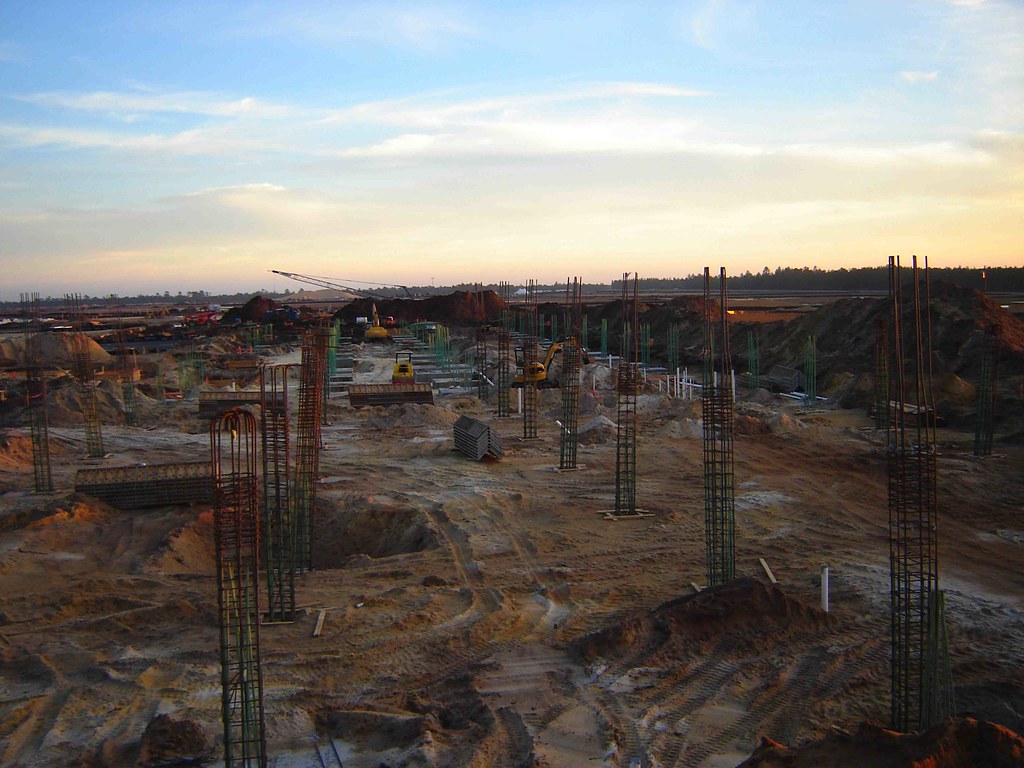
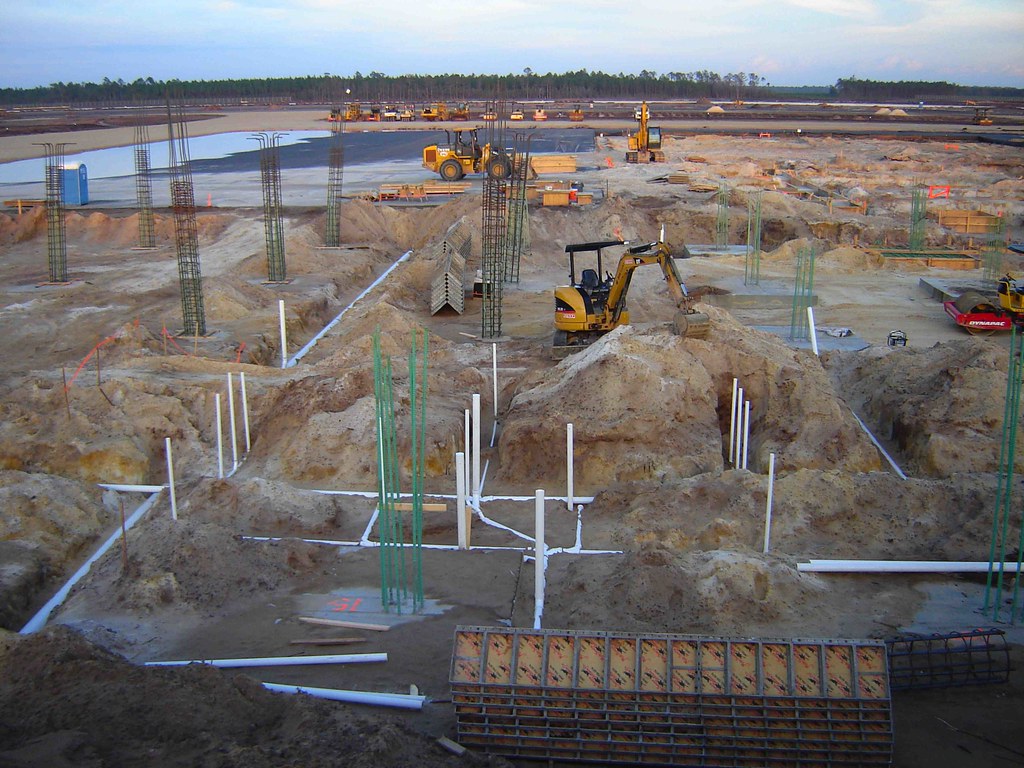
Airport Construction Update – Terminal 18% Complete

Contract 1: Heavy Civil and Airfield Lighting
Approximately 80% of the contract work is complete with only 54% of the contract time used.

  • 90% of the 15” concrete paving lanes have been placed on 8,400 linear feet of Runway 16-34.
  • On Taxiway D and main terminal apron, all lime rock base and the first lift of asphalt paving is in place with the 2nd of four lifts going down this week.
  • The centerline cans on the runway are approximately 36% complete.
  • The lighting cans in the Touch-down zone are approximately 55% complete.
  • Paving will begin this week on the General Aviation Access road.
  • 150 pieces of heavy equipment are in operation at any one time with approximately 200 personnel on site for the heavy civil and utilities contracts.

Contract 2:  Terminal Building, ATCT and Support Buildings
Approximately 18% of contract work is complete with 22.6% of contract time utilized.

Terminal:
Concrete pouring complete for Level 2 Area A. Shoring of Level 2 Areas B and C continues

Air Traffic Control Tower:
Cutting of auger cast piles to design length is complete. Forming for the pile cap has started.

Air Maintenance Facility:
Forming for pit walls continues.

Air Cargo Facility:
Continuing the installation of the pre-engineered metal building.

Public Safety Building:
Rough-in of the plumbing continues.

Rental Car Facility:
Installation of underground facilities continues.

Manpower:
The average man power on site for Contract 2 per day is 95 people based on a five day work week.

Contract 3:  Utility Contract
Approximately 8% of contract work is complete with 11% of contract time utilized.

Main Access Road:
3W2” Power Distribution Duct Bank is 36% complete.
Street light duct work is 50% complete.

Joyner Road:
24” directional bore is complete.
24” water main is 36% complete.

GA Access Road:
30” water main is 9% complete.

Lift Station:
Wet Well is installed.

Source: www.NewPCAirport.com

Panama City Beach Adopts Improved Planning Codes

Imagine hidden parking garages, not of the Batman variant, but of the variant of being hidden behind facades or landscaped walkways.  Think beautified pedestrian walkways and shop entrance ingress and egress without risk of being mowed over by an auto.  Pretend you are one of those developers that don’t do any work and make tons of money (please note the sarcasm here).  Imagine reaping the rewards of not only high density, but planning codes that allow you to achieve that high density in a way that is very asthetically pleasing and doesn’t hack off the neighbors with behemoth towers.  Enter the new Form-Based Code Building Regulations.

Before last week’s Panama City Beach City Council meeting, there was a public workshop held at Beach City Hall discussing the future of land planning for our area’s beach community.  Attended mostly by City employees and a few developers and architects, the only other people there were media and the land owner of one of the example properties used for the analysis.

So, what are Form-Based Codes, you say?  Straight out of the 11×17 color printed packet I received at the workshop:

The Form-Based Codes Institute defines form-based codes as a “method of regulating development to achieve a specific urban form. Form-based codes create a predictable public realm primarily by controlling physical form, with a lesser focus on land use, through city or county regulations.”2 While conventional zoning tends to focus on uses, intensities and setbacks, form-based codes focus on building scale and character. The key distinctions between form-based codes and design guidelines are that guidelines are advisory and often subjective, which frequently result in the need for design review boards. Form-based codes establish specific, measurable standards that require little discretion and limited architectural knowledge.

The best form-based regulations address site-specific challenges and conditions that are ignored by conventional zoning. They promote compatibility between adjacent uses through context-sensitive design. They also tend to do a much better job of addressing the interface between the public and private realms (streets and buildings). They also are better suited to addressing scale and building orientation in ways that improve compatibility between adjacent public and private uses.

Rather than focusing exclusively on “one-size-fits-all” setbacks and building heights, form-based codes may include different standards for different situations. For instance, height limitations and setbacks may depend on the proximity to lower intensity zoning districts. Conventional zoning commonly ignores the orientation of a building, allowing entries, garage openings and mechanical equipment to be located on any side. Form-based codes typically require entries to face the street, while garage openings and mechanical equipment are hidden from main streets.

Reference page 6 of the code packet available for download below.

Now, I know what you are thinking:  Where was this five years ago?  Well, my friend, I don’t have the answer to that, but it was conveyed by many of the council members that they had wished we had something like this in place years ago, and that if it wasn’t adopted, they would regret it in the future.

Some of the advantages outlines in the proposal are:

  • They describe what is allowed, in addition to setting limits and focusing on prohibited designs. This gives project designers a clearer picture of desired outcomes.
  • They better accommodate infill and redevelopment because of their focus on scale, orientation and other critical design elements.
  • They may specify specific architectural styles, materials and uses, which provides greater design predictability for property owners and neighbors.
  • They can be adapted to ensure compatibility in widely varying settings.
  • They are easy to apply in small communities because they do not require architectural expertise to use, interpret or administer.
  • They are more readily defensible than design guidelines and architectural review processes that involve more subjective decisions.

As part of the proposal, three independent site studies were conducted named Back Beach, Long Beach and Tidewater.  The Back Beach study is located on Back Beach Road, between Colina Drive and Pearl Avenue.  The Long Beach study is located on the north side of Front Beach Road, between Gulfside Drive and Henley Drive.  The Tidewater study is located north of and across Front Beach Road from the Tidewater Condominium Resort.  The study sites were used purely as examples with no necessary intention of this actually happening to these properties.

The Back Beach Road study sample currently consists of  24,000 sf of commercial space, 22,500 sf of manufacturing space and 0 sf of residential units.  Based on the Form-Based Code, the future development possibilities could include over 54,000 total square feet of commercial space and 14 residential units.  The actual building layout would be such that the parking would be in the back, away from pedestrian walkways with limited access.  This would enhance beautification and create a more pedestrian-friendly area.

The Long Beach study currently allows for 131,200 sf of commercial space and 27 residential units.  Based on the Form-Based Code, a over 249,000 sf of commercial space would be possible, with over 145 residential units.

The whole process would work on a tiered system.  Developers would be allowed greater density the more emphasis they put on beautification towards concealing that density.  One of the greatest examples of this in action is the way the Village of Baytowne Wharf was developed and the proposed plans for the Towne of Seahaven.  In Baytowne, the main parking garage is hidden on all sides and the top with walls, landscaping and residential units.  The side of the parking garage that is facing the “towne” part of the village is where retail is located and above that is residential.  In the center, which is actually the roof of the parking garage is the amenity area for the residential component, including lush landscaping, fitness center and the pool.

Look at Pier Park.  Notice the huge open parking areas in the back but where people congregate is beautified?  This is all intentional and is the direction the City of Panama City Beach is going.  This is an exciting step and much and long needed for our area.

Download the full Analysis of Opportunities here (7.3 mb)

Beckrich Road Opens New Lane

Working under the ever watchful eye of the warm sun, workers barely break a sweat in the mild 59 degree weather.  Clear blue skies with a light breeze make for perfect working conditions.

Recently new light posts have been installed along new sidewalks on Beckrich Road as part of the Community Redevelopment Area in Panama City Beach, also known as the CRA..  The posts are stylish and resemble something like what you would find in Stars Hollow, the sidewalks are concrete and whitish-grey in color and will one day very soon be walked on by the size 11 shoe of both tourists and locals alike.

Straining under the weight of the immense weight of the broken bits of road, a Caterpillar tractor lifts itself off the ground as the scoops grow larger and larger.  Heavy equipment has just gnarled the section of Beckrich that comes up to Back Beach Road in preparation for a new layer of hot smooth asphalt.

Sod has gone down, curbing is in place and bugs and other creeping things have a new home in the median vegetation that actually looks quite beautiful and refreshing.  Neat rows of palm trees add to the feel of modern sophistication Panama City Beach has for so long deserved.  No more power or phone lines either.  Sweet.

Workers labor diligently to get the new traffic lights installed at the intersection of Middle Beach  and Beckrich Road.  Panama City Beach Police Department employees have been directing traffic all morning.  “It’s pretty dangerous out here.  We almost get hit every now and then, ” one officer didn’t tell me earlier.

Starting today, northbound traffic on Beckrich used the newly paved lane with the southbound traffic using the same lane as was used last week.  Still only two lanes of traffic traverse the route.  The entrance to Edgewater Shopping Plaza was a mud pit as recently as last week, but now it is silky smooth pavement.

Construction should be totally complete in two months.

New Aerials of the New Panama City Bay County International Airport

New aerials have been released of the construction progress at the new aiport site in West Bay in North Bay County.  The new airport in Panama City Beach is located on 4,000 acres of land donated by the St. Joe Company with the current infrastructure footprint using 1400 acres of the property.

This photo shows the terminal and main parking area.  The left side of the picture is south whereas the right side of the picture is north (or approximately).  The U-shape onthe bottom is the pavement around the main wing of the terminal with the T-shape (with the stem of the T fitting in the U) being the actual terminal footprint.  The box-shapes above the terminal area is the main parking with the cleared area above it (I beleive) will be auxilary parking.  The area to the left is the general aviation area.

Project Update – New Panama City Airport

Contract 1: Heavy Civil and Airfield Lighting

On the Heavy Civil and Airfield Lighting contract, the construction team has completed 75% of the contract work and used only 51% of the contract time.  The following milestones have been reached:

  • 85% of the 15” concrete paving lanes have been placed on 8,400 linear feet of Runway 16-34.
  • Runway 16-34 Touch Down Zone and Centerline light cans are being set.
  • On Taxiway D and main terminal apron, all lime rock base and the first lift of asphalt paving is in place.

Production volumes in place are as follows:

  • 62,354 tons of asphalt pavement in place (both airside and landside).
  • 151,307 square yards of landside lime rock base and 130,885 square yards of flightline P-211 lime rock base have been installed in accordance with the project specifications.
  • 47,000 cubic yards of the 67,200 cubic yards of 15” concrete runway pavement is in place.
  • 98% of the original RCP storm sewer installations are complete (33,086 linear feet).
  • 66,258 linear feet of perforated under-drain has been installed along the taxiways and runways (42% of total).Storm sewer installation within the General Aviation Area is 30% complete.
  • 5.7 million cubic yards of earth has been moved (99% of total).
  • Mass grading within Pond C now 98% complete.
  • 105 pieces of heavy equipment in operation at any one time with approximately 123 personnel on site.

Contract 2:  Terminal Building, ATCT and Support Buildings

On the Terminal Building, ATCT and Support Buildings contract, the construction team has completed 14% of contract work and utilized 19% of the contract time.  Specific work includes the following:

  • Terminal: Shoring for Level 2 areas B and C continues in the terminal building.
  • Terminal: Plumbing rough-in continues.
  • Air Traffic Control Tower: Excavation around auger cast piles is complete and ready for installation of pile cap.
  • Air Cargo Facility: Completed slab pour at truck well/forming retaining walls.
  • Public Safety Building: Rebar at perimeter footings nearly complete.

Contract 3:  Utility Contract

On the Utility Contract, the construction team has completed 4% of contract work and utilized 6% of the contract time.  On the Main Access Road:

  • 12” water main:  38% complete
  • 8” force main:  38% complete
  • 3W2” Power Distribution Duct Bank: 26% complete
  • Street light duct work: 36% complete

Source: newpcairport.com

More Sidewalks on South Thomas Drive

021109_thomas_sidewalk

Well, the County is doing it again – using your tax dollars for improvement.  Good for you Bay County.  The project started back in June and paved sidewalks from the intersection of Joan Avenue to Ocean Street.  Now the project continues from Ocean street down to Venus Street.

This phase in the construction includes the installation of a stormwater system consiting of three 18 inch diameter cross drain pipes under Thomas Drive bewtween Choctaw and Walnut Streets. Over the last 10 days sections of Thomas Drive have been closed on one side to accomodate the construction.

Guy Harvey's in Pier Park to Open Soon

Guy Harvey’s Island Grill in Pier Park will be open first part of April, as long as everything goes according to schedule.  Interior construction is heavy under way on the 10,000 square foot restaurant and shop and is located at the south side of Pier Park, right next to Reggae J’s and across from Back Porch and Margaritaville.

This will be Guy Harvey’s fifth location with others located in Orange Beach, AL, Marco Island, Key West and Grand Cayman.

The Pier Park location will feature a restaurant that will seat around 200 people and a shop where tourists and locals alike can purchase merchandise from artwork to belts adorned with various sea wild-life.  There will be two levels, although at this time, I’m unsure what the second floor will hold.

The menu will include similar items as the other locations with a few “local” adaptations.  However, you will not see on the menu items such as swordfish, chilean sea bass, grouper, or any other billfish or shark species for that matter.  Guy Harvey deems these species threatened or depleted.

Visit www.GuyHarveyInc.com for more details on Guy Harvey, and check the picture below to see what the place looks like inside, right now.

County to Charge for Access to New Pier

_mg_0735_2Since apparently I’m all about people having to pay more for stuff, you would think that I would agree with Bay County deciding to charge the same fee as Panama City Beach did (and will in the future) for using the pier – and you would actually be correct.  However, not at first.

I’ll be frank, the only real objection I have to paying a fee at a place like this is because I’m not usually carrying cash.  I don’t remember if they accepted credit cards, but who likes to charge a dollar anyway.  Plus, who wants to pay $6 just to take the wife and kids out to the end of the pier for 10 minutes on the remote chance that we’ll actually see a fish that is radical enough to entertain the kids.  I mean, seriously, $6 for something that I’ve already paid for through being a tax-payer?

_mg_0732_2But, the reality of the situation is that the tax dollars that I’ve put towards (or actually will put towards in the future as I’m sure this was financed through bonds) our new pier(s) is actually going to the construction, not the upkeep.  An article in the paper this morning quoted Mike Thomas as stating that Bay County has never run a pier, they just built M.B. Miller Pier and let it run down.  This brings up an interesting point.

_mg_0763_2Why did I never go to the county pier years ago even though there is tons of space and could be a perfect place for families to hang what with all the setting areas, boardwalks and wide open spaces?   *pause*  Because it was scary.  That’s right, I said it – SCARY.  With the fees, the county would be able to pay for running operating expenses, such as security and pay staff to be onsite.  Now, I know what some of you are thinking – Eliminate the fees and  pay for the running costs with other county fees, just reallocate, adjust budgets in other categories or fire a couple unneeded people.  I know, I know, sounds like a great idea, but you know that the county doesn’t work that way, in fact what municipality does?  You can’t expect government to pay for something NOT directly associated with it.

_mg_0766_2So, with that said, knowing that the money can’t come from anywhere else, I totally agree with the usage fee.  I want both piers to be on an equal playing field and I want to be able to use either one safely.  Do I like paying the fee?  Not really, but it isn’t because I’m always broke, its more of just an inconvenience, but I’ll find a few bucks if I want to go to the pier, as long as there will be tons of other people there enjoying it with their families and not a bunch of punk drunks.

The twin county and city piers, dubbed M.B. Miller and Dan Russell, respectively will be identical, measuring 1.500 feet long.  The cost is a little more than they style pier that was there before, but they are designed to sustain damage in a more efficient way in order to minimize the cost of repair in the future.

The fees for access to the pier are $5 per adult fisherman, $2 per child fisherman and $1 if you just want to watch.

Main Runway is PAVED at New Airport – VIDEO!

That’s right, the approved 8,400 feet of the main runway at the new airport site in Panama City is complete.  With the exception of the center where the runway lights will be installed, they are done.  Approval should come shortly from the FAA for the extension to the full 10,000 feet which will take just over 14 days to complete.

Onsite, they have the capability to produce concrete at the pace of filling a new mixing truck every 2.5 minutes so the actual paving goes pretty quick.  The concrete layer is 15 inches thick and it lays on top of 4 inches of asphalt.  The density is also much greater than the stuff you use to to pour your home’s foundation.

The terminal barely resembles a frame right now but is coming along.  Construction time on the terminal will last almost the duration of the project, along with te air traffic control tower.  The air traffic control tower has 72 piles already installed that reach 45 feet into the earth.  Instead of using pre-cast piles, they used auger-cast piles said Roy Willett, Senior Project Manager of KBR.  Auger-cast piles are set by drilling into the ground, and as the dirt comes up, it is replaced with concrete, all the while placing a steel rebar pole down the middle for reinforcement.  In the video, you can see where the earth movers are digging around the rebar to clear out the top of the pilings.

In my interview with Dr. Ed Wright, stand-in director of the Bay County Economic Development Alliance, it was mentioned that he wasn’t sure if the new airport would need any modifications with regards to turn-radius/taxiway requirements to accommodate the large Airbus A380 or other large cargo aircraft.  Willett confirmed that short of the largest of the Antonov and the largest of the Airforce’s cargo planes, the new airport will be able to accommodate it all with the 10,000 foot runway – turning radii and all.  Awesome, just flat-out awesome.!

I took some great footage this trip, enjoy!

http://vimeo.com/moogaloop.swf?clip_id=3070601&server=vimeo.com&show_title=0&show_byline=0&show_portrait=0&color=00ADEF&fullscreen=1
January Airport Construction Update from Jason Koertge on Vimeo.

The Panama City Airport relocation is moving along quickly with the main runway almost completely paved. The prep work has been done for the extension to 10,000 and upon FAA approval, will be complete within a couple weeks. The Terminal is under construction, as well as the air traffic control tower.

Here are the photos.